

Adblockers cut network requests by more than half, conserve a third of bandwidth usage, and spare every user two days of loading time annually, according to a fresh report by AdGuard. These advantages come in addition to adblockers’ primary purpose: defeating intrusive ads, malvertising, tracking, and other annoyances.

Loading even a single news website typically triggers hundreds of network requests. Only some are required to load the article and deliver multiple assets, like CSS or JS files. Most are dispatched to third-party trackers, advertising platforms, and related services.
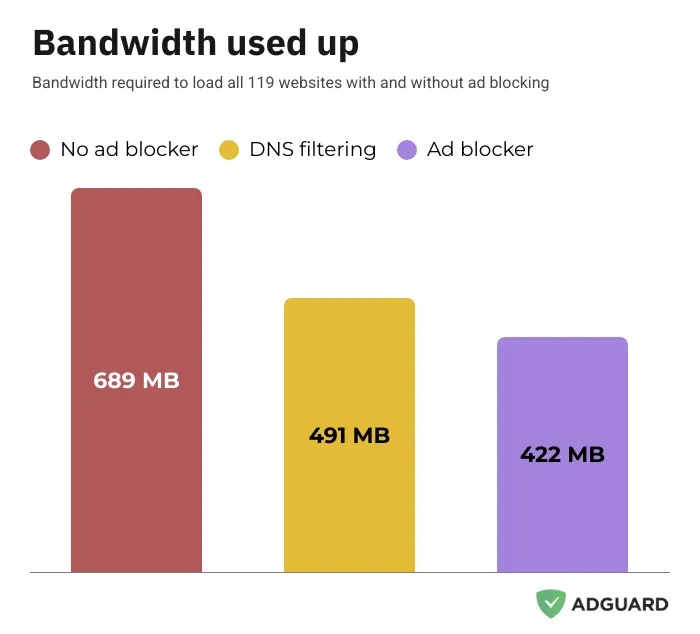
Loading 119 popular news websites in the US consumes over 22 minutes, 35,603 network requests, and 689 megabytes (MB) of bandwidth usage, as measured by AdGuard, a company delivering adblocker and other security and privacy services.
Fourteen of the analyzed websites weighed more than 10MB, some even surpassing 15MB, and the average was 5.79MB per website.
Adding an adblocker conserves 30-40% of bandwidth and 45% of load time.

The firm discovered that utilizing an adblocker slashed the loading time of an average website by 5.1 seconds, from 11.3 to 6.2 seconds, and trimmed 2.2MB off the bandwidth for each website on average. Small savings accumulate to massive numbers over time.
To load all 119 websites with an adblocker, it required 422 MB of bandwidth instead of 689 MB. The total number of requests decreased by more than half, from 35,603 to 17,249. And the time needed to load the websites dropped from over 22 minutes to 12 minutes and 17 seconds.
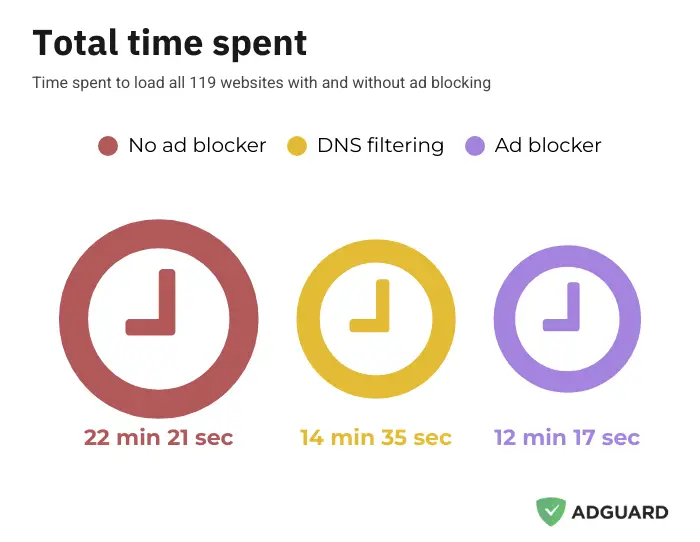
Two Days’ Worth of Loading Each Year
Utilizing a conservative estimate that an average person visits 100 websites every day, AdGuard concludes that they can save two entire days every year.
“We can estimate that every year, ads and trackers cost you roughly 80GB of bandwidth and 52 hours of your time. That’s more than two entire days!” reads the company’s report about adblockers’ impact on web performance.
However, this figure doesn’t necessarily mean that users are staring at a blank screen until everything loads. Page load time measures the completion of network activity, not when the first content becomes visible to the user.

Moreover, AdGuard’s experiment cleared the browser cache and deleted cookies before each load. In real-world browsing, cached assets significantly reduce the time required for subsequent website loads.
Still, the report highlights the significant hidden overhead that ads and trackers impose on everyday browsing.
“For ads to show up on your device, they have to be loaded first, and loading them consumes traffic and time. By blocking ads, you not only spare your nervous system from another assault, but also save time and data,” the report reads.

“Trackers aren’t much better in that regard. They are usually less traffic-consuming than high-res banners and lengthy video ads, but there are a lot of them, and it adds up.”
Across the sample of 119 websites, AdGuard detected 276 unique trackers belonging to 233 firms. The websites made requests to 829 distinct tracking domains, highlighting that a single tracking script shares user data with multiple domains.
“Popular trackers operate on thousands, if not millions, of websites, and the big players on the market can easily own multiple trackers (think Google),” the firm explains.
“115 of 119 websites (or 97%) connected to at least one tracker owned by Google.”
The US Cybersecurity and Infrastructure Security Agency (CISA), the Federal Bureau of Investigation (FBI), and other cybersecurity authorities have been recommending the use of adblockers.
Adblockers reduce the risk of malicious ads or redirects to phishing websites, enhance client-side performance, load pages more quickly, and minimize the risk of data collection by third parties.